

AT REGISTRATION


PFC 1(C)(II)(a) · Regulation (EU) 2019/1009

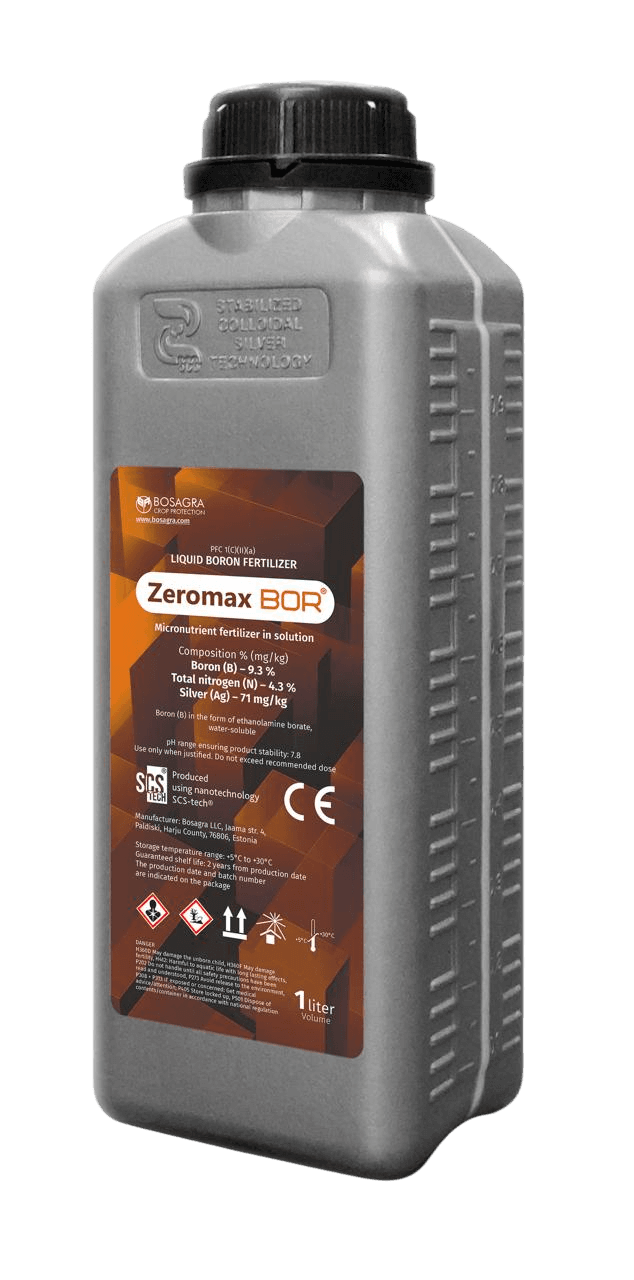
LIQUID BORON FERTILIZER WITH STABILIZED SILVER NANOCOMPOSITE (SCS-TECH®)

MAIN INGREDIENTS:

Boron (B) — 10.0%

i

Total Nitrogen (N) — 4.3%

i

Silver (Ag) — 0.0075%

i

PRODUCT POSITIONING:

Zeromax BOR® is a foliar boron fertilizer engineered for cropping systems where conventional borates underperform — high temperatures, low relative humidity, restricted irrigation. The formulation combines a water-soluble boron carrier with an amide nitrogen co-factor and a stabilized silver nanocomposite acting as a plant-immunity elicitor. The product belongs to the next-generation SCS-Tech® range: a nutrient–elicitor architecture in which the silver nanocomposite is not an antimicrobial agent, but an engineered trigger of the plant's own defense machinery.
WHY THE FORMULATION WORKS IN ARID CONDITIONS

Standard borates crystallize and lose mobility as leaf surface humidity drops. In Zeromax BOR®, boron is co-formulated with an amide nitrogen carrier and an SCS-Tech® stabilizer matrix that:


  1. maintains the active ingredient in a mobile, plant-available form on the leaf surface during evaporative stress;
  2. supports cuticular penetration without surfactant overload;
  3. extends the functional window of uptake to 10–14 days after application.

MODE OF ACTION — ENGINEERED CASCADE

  1. Boron (B) — reproductive and structural function

    Boron is co-factor in cell-wall pectin cross-linking, pollen tube elongation and sugar translocation toward reproductive sinks. These are the first processes to fail under heat and drought.

  2. Amide nitrogen (N) — metabolic co-factor

    The amide-N fraction serves as a co-factor that supports protein synthesis and improves the assimilation profile of boron in the leaf. It is not the macronutrient component of the product.

  3. Stabilized silver nanocomposite — engineered elicitor

    The SCS-Tech® nanocomposite is recognized by the plant as a danger-associated signal. This triggers a defined signaling cascade in the plant itself:

    Silver nanocomposite recognized at the cell membrane

    Controlled apoplastic ROS burst (H2O2)

    MAPK signaling cascade activated

    Salicylic acid / jasmonic acid pathways engaged

    SAR (Systemic Acquired Resistance) + ISR (Induced Systemic Resistance)

    PR-protein expression · phytoalexin biosynthesis · cell wall reinforcement (callose, lignin)

    Plant enters a primed, pre-activated defense state

The plant's own immune system is brought to a pre-activated state. Defense is faster and stronger when biotic or abiotic stress arrives — not because the product acts against pathogens, but because the crop is ready before they do.

DEMONSTRATED AGRONOMIC EFFECTS

  • Pollen viability and fertilization preserved under heat stress
  • Reduced flower abortion and fruit drop
  • More uniform fruit and seed set
  • Reduced incidence of cracking and physiological disorders linked to B deficiency
  • Higher tolerance to drought, heat and wind stress under field conditions
  • Functional window of action: up to 14 days, rain-fast performance

CROP YIELD RESPONSE (VS. UNTREATED CONTROL)

Crop groupObserved yield response
Sunflower, rapeseed, flax+12–25%
Pome and stone fruits, grape+10–20%
Tomato, pepper, cucumber, cabbage+12–20%
Sugar beet+10–18%
Cotton+12–20%
Root vegetables (carrot, beet, potato)+8–15%

Ranges based on multi-season field observations; final values per region to be confirmed by your trial dataset.

APPLICATION RECOMMENDATIONS

CropGrowth stageRateSpray volumeApplications
Oilseeds6–8 leaves → budding0.5–1.0 L/ha150–300 L/ha1–2
Fruit, vegetable, technical cropsPre- and post-flowering0.5–1.0 L/ha300–600 L/ha1–2

Compatible with most plant protection products and foliar fertilizers. Jar test recommended with strongly alkaline solutions or concentrated phosphites.